

Baku — A City of Musical Freedom on the Caspia
Larisa Javanshir
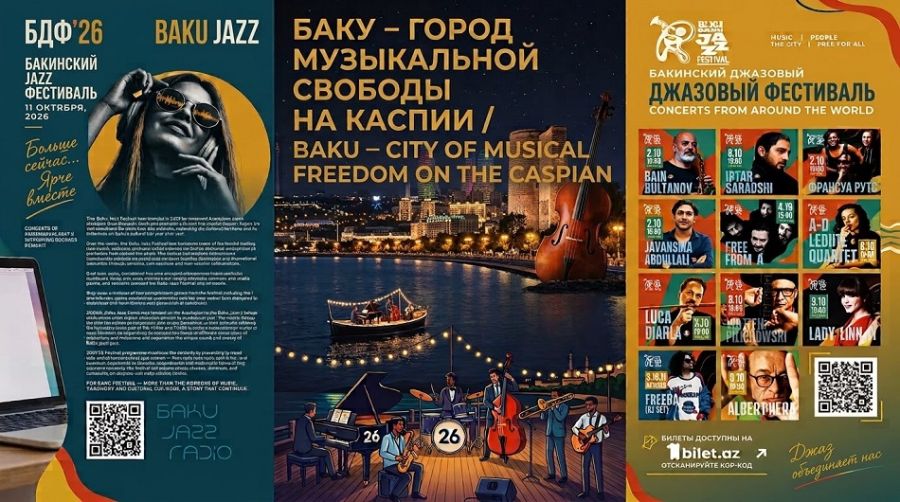
3–11 October 2026 — The 21st Baku Jazz Festival is taking place in Azerbaijan’s capital, bringing together artists from more than 12 countries.
This year’s innovations include the launch of the first dedicated online jazz radio station broadcasting exclusively Azerbaijani jazz. Alongside the festival’s established venues, including Elektra Events Hall and the International Mugham Center, the programme features large-scale free open-air concerts in the very heart of the Old City, Icherisheher, near the Maiden Tower.
Over the years, Baku Jazz Festival has welcomed Grammy Award winners and some of the world’s leading jazz artists, including Al Di Meola, Diana Krall, Marcus Miller, Chick Corea, Herbie Hancock, Joe Zawinul, David Sanborn and many others. The young-talent competition “I am Jazzman” remains a permanent feature of the festival, introducing new names to Azerbaijan’s jazz scene.
Baku is a city of music. Time and again, the Azerbaijani capital reaffirms this image and demonstrates its unique place on the world’s musical map.
The Birth of a Tradition
1938 — Composers Niyazi and Tofig Guliyev establish the first State Variety Orchestra, effectively Azerbaijan’s first state jazz orchestra, in Baku, laying the foundations of the Azerbaijani jazz school. It was during this period that jazz improvisation and the national tradition of mugham first began to converge.
The 1960s — Baku acquires the unofficial reputation of the “jazz capital of the USSR.” Pianist Vagif Mustafazadeh and the vocal quartet Gaya help transform the musical landscape, ultimately shaping a distinctive new idiom: jazz-mugham.
1969 — Baku hosts its first official jazz festival. The legendary Vagif Mustafazadeh emerges as the winner of this historic event. Later, for political reasons associated with the Soviet era, the large-scale festival tradition is interrupted for many years.
The Baku Jazz Festival Era: Revival and International Recognition
2005 — Honoured Artist of Azerbaijan and saxophonist Rain Sultanov founds the Baku International Jazz Festival with the support of the Ministry of Culture. The landmark 14-day festival is held in April and brings together musicians from 12 countries. Its principal guest is the iconic Joe Zawinul Syndicate. From this point onward, the festival becomes an annual event.
2006 — The Baku Jazz Festival is officially recognised among the world’s major jazz festivals. The second edition is headlined by such towering figures of international jazz as Herbie Hancock and Al Jarreau.
2016–2017 — Baku Jazz Festival takes a major step towards deeper integration with the international jazz community and officially joins the Europe Jazz Network. Richard Bona and Branford Marsalis are among the artists appearing on Baku stages.
2018 — The project broadens its international reach by joining celebrations of International Jazz Day under the auspices of UNESCO. Baku’s musical chronicles begin to receive coverage on Euronews.
The pandemic period — The festival demonstrates its flexibility and technological adaptability, responding to global restrictions by moving fully online.
2025 — The festival celebrates its 20th anniversary on a grand scale, firmly established as one of Azerbaijan’s leading cultural brands and an important bridge of cultural diplomacy.
An Island of Musical Freedom on the Caspian
The question of how jazz could establish such a lasting presence in Baku as early as 1938 continues to fascinate true lovers of the genre. Part of the answer lies in Baku itself — a city with an extraordinary, almost storybook history.
Baku did not become a metropolis overnight. Its story is a journey from a small fortified settlement to one of the largest industrial and cultural centres of the Caucasus. The earliest traces of human settlement on the Absheron Peninsula date back to deep antiquity. Archaeological discoveries show that people lived here thousands of years ago, drawn by the peninsula’s unique geographical position and by natural oil and gas seepages that burned with seemingly eternal flames. These “eternal fires” helped give the region its poetic identity as the “Land of Fire.”
The origin of the name Baku (Bakı) has been linked by historians to ancient languages. One of the best-known interpretations derives it from the Persian “Bad-kube,” commonly understood as “wind-beaten” or “city of winds.” The name seems perfectly suited to the harsh Caspian climate, famous for its powerful Khazri and Gilavar winds.
The true beginning of Baku as a fortified and important city is inseparable from Icherisheher, the Old City. Enclosed by massive defensive walls, this quarter remained the heart of Baku for centuries. In the 12th century, following a devastating earthquake in the ancient capital of Shamakhi, Shirvanshah Akhsitan I transferred his residence to Baku. The city became a capital of the Shirvanshah state. It was within this historical environment that the remarkable architectural ensemble now protected by UNESCO took shape, including the majestic Palace of the Shirvanshahs and the enigmatic Maiden Tower, whose exact age and original purpose continue to be debated by scholars.
A new chapter — and an extraordinary leap in the city’s development — began in the 19th century. In 1848, at Bibi-Heybat near Baku, an oil well was drilled mechanically, years before the famous Pennsylvania oil well in the United States. This helped transform Baku into a global centre of “black gold.” If America had its celebrated Gold Rush, Baku, standing on the shores of the ancient Khazar — the Caspian Sea — experienced a comparable phenomenon that became known as the Oil Boom.
Capital poured into the city from major industrialists, including the Nobel brothers and the Rothschilds. By the beginning of the 20th century, Baku was producing more than half of the world’s oil.
The city’s architecture changed just as dramatically. Thanks to oil magnates such as Haji Zeynalabdin Taghiyev, Baku rapidly expanded beyond its fortress walls. Lavish mansions appeared in European styles — Art Nouveau, Gothic and Baroque — earning the city the nickname “Paris of the Caucasus.” Baku combined the colour of ancient Eastern traditions with European elegance, the atmosphere of the oil boom and the free spirit of a port city. This unusual blend created ideal conditions for the city, having established its first jazz orchestra, to embrace and develop jazz culture with equal passion in the 20th century.
An Island of Musical Freedom on the Caspian
To understand why Baku became one of the great strongholds of Soviet jazz, one has to look at the city’s distinctive atmosphere in the mid-20th century. While jazz musicians elsewhere in the Soviet Union could face official suspicion and imported records might bring serious trouble, Baku remained a remarkable oasis of relative creative freedom. Three factors were especially important.
Baku’s Geographical Position
As the largest port on the Caspian Sea and a major international industrial hub, Baku had always been open to the wider world. Sailors returning from foreign voyages brought home not only fabrics and technology, but also rare vinyl records.
The particular geography of the Absheron Peninsula also enabled Baku residents to tune in to foreign radio broadcasts. Late at night, young musicians would gather around VEF radio sets, listening through the interference to Willis Conover’s legendary jazz programmes on Voice of America. Music born in New Orleans and New York was quickly absorbed, transcribed and reimagined in Baku’s rehearsal rooms.
The Boulevard, Where Swing Found a Home
The famous Seaside Boulevard became the heart of Baku’s musical freedom. During the 1950s and 1960s, jazz standards could be heard in numerous open-air cafés, pavilions and dance venues along the waterfront.
The summer stage on the Boulevard and the celebrated Green Theatre regularly hosted jazz orchestras. People strolling by the sea could listen openly to improvisations by local ensembles. Musicians themselves recalled the surprisingly tolerant attitude of the city authorities towards jazz enthusiasts. In Baku, jazz was not associated with hooliganism; rather, it became a marker of sophistication, education and cultural curiosity.
The Remarkable Support of the Cultural Elite
Perhaps the most paradoxical factor in the survival of jazz in Baku was the attitude of the local establishment. Azerbaijan’s cultural and political elite included highly educated people with a genuine love of music.
Instead of treating every jazz influence simply as “kowtowing to the West,” many officials took pride in local musical talent. They understood that, in the hands of Azerbaijani musicians, jazz was acquiring a refined and distinctive voice. This tacit support helped Baku stage an official, legal jazz festival by the late 1960s and reinforced the city’s reputation as one of the Soviet Union’s great centres of jazz.
Why Did American Jazz Take Root So Naturally on the Caspian?
Jazz emerged in New Orleans from a complex meeting of African musical traditions and European harmony. Mugham, by contrast, is an ancient and deeply spiritual art of the East, developed over centuries according to sophisticated modal principles. Yet a closer look reveals that the relationship between American jazz and Baku’s musical traditions was not accidental. It reflected a profound affinity between two great cultures and ultimately gave birth to an entirely new genre.
At first glance, American jazz and classical Azerbaijani mugham seem to belong to completely different musical universes. But when the two traditions met in Baku in the mid-20th century, musicians discovered that they shared a common musical DNA.
The Point of Convergence: The Magic of Free Improvisation
The central principle uniting jazz and mugham is the art of improvisation. In classical European music, the performer generally follows a score written by the composer. In jazz and mugham, the musician becomes a co-creator in the moment. A jazz performer develops and transforms a theme, while a khananda — a traditional mugham singer — creates within the canonical framework of a mode. In both traditions, music comes into being anew in the act of performance.
Baku musicians immediately sensed this intellectual, emotional and technical kinship. They realised that jazz swing and the subtle microtonal language of the East could do more than coexist: each could enrich the other.
The Birth of Jazz-Mugham: Vagif Mustafazadeh’s Revolution
The story of Baku’s musical phenomenon reached a new height with the arrival of pianist and composer Vagif Mustafazadeh. Mugham was a profound, canonical Eastern art shaped over centuries by the laws of modal music. Jazz represented an American language of freedom, improvisation and swing. Their fusion might have seemed impossible.
But Mustafazadeh possessed an extraordinary ear. He achieved a genuine musical breakthrough, making the concert piano speak with the inflections of traditional Azerbaijani instruments such as the tar and kamancha. He brought microtonal nuances, intricate ornamentation and the philosophical architecture of the mugham dastgah into dialogue with jazz harmony and rhythm. From this synthesis emerged a distinctive new genre: jazz-mugham.
His genius lay in the fact that he did not simply place an Eastern melody over a jazz rhythm. He transformed the very language of the piano, allowing it to evoke the sound world of the tar and kamancha. This hybrid style became one of Azerbaijan’s most distinctive contributions to global musical culture.
Mustafazadeh’s originality won admiration far beyond Azerbaijan. A widely repeated account attributes to the great American trumpeter Dizzy Gillespie, after hearing Mustafazadeh in 1966, the striking assessment that the Azerbaijani pianist had created “the music of the future.”
Mustafazadeh brought the microchromatic detail, elaborate melismas and meditative dramatic development of Azerbaijani mugham into the world of jazz harmony and swing. Jazz-mugham — sometimes described more broadly as ethno-jazz — was born. Depending on the performer and the moment, either the jazz foundation or the depth of mugham may come to the fore, but the essence remains a dialogue between equals.
Mustafazadeh died in 1979 at the age of 39, after falling ill during a performance, but the legacy he left behind permanently changed the development of ethno-jazz.
In 1979, his jazz-mugham composition “Waiting for Aziza” was awarded the Grand Prix — the “White Piano” — at the International Jazz Composition Competition in Monaco.
His daughter, Aziza Mustafa Zadeh, carried the tradition forward, combining jazz-mugham with a powerful vocal style and elements of classical music.
Today, this dialogue between traditions continues in the work of internationally recognised Azerbaijani musicians such as Shahin Novrasli and Montreux competition laureate Isfar Sarabski. They boldly bring ancient musical heritage into conversation with electronic jazz, progressive rock and classical music, proving that Baku’s jazz tradition is not a museum piece: it is alive, evolving and still creating new forms.