

Humanitarian Diplomacy Without Borders: How the Baku Dialogue Became an Official UN Agenda
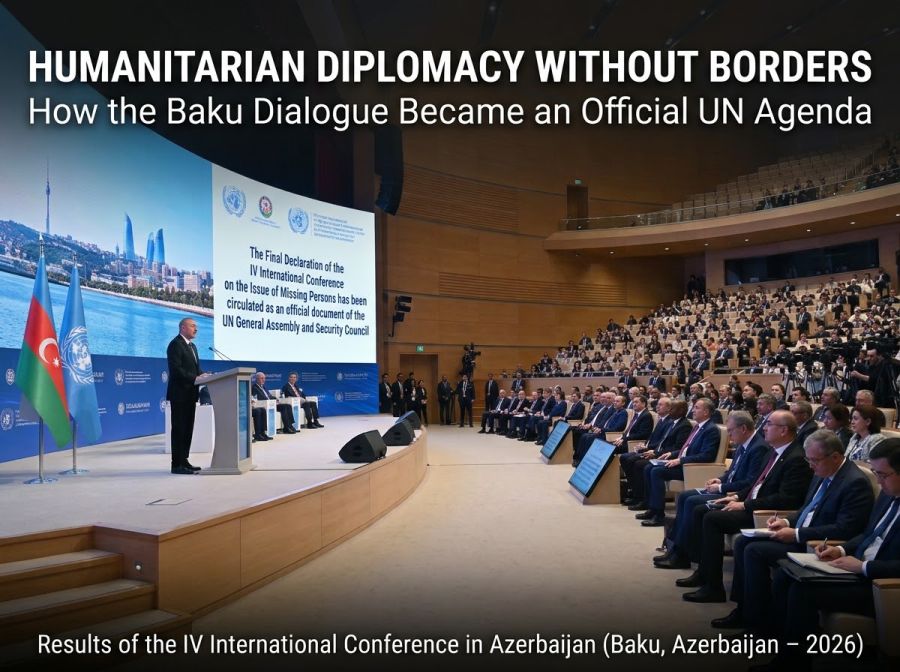
Outcomes of the 4th International Conference in Azerbaijan, uniting politicians, scientists, and families of missing persons from dozens of countries worldwide
Bakuinform.az
The official circulation of the final declaration of the 4th International Conference within the framework of the Baku Dialogue (A/81/462–S/2026/849) in the UN General Assembly and Security Council elevates the issue of persons missing in armed conflicts to the level of global norm-setting. Adopted in Azerbaijan (the forum took place on October 7–10 and was submitted to the UN Secretariat on October 27), the document establishes an international platform for creating a specialized UN mechanism to determine the fate of tens of thousands of people disappearing in war zones worldwide—from the South Caucasus and the Balkans to the Middle East and Eastern Europe.
From a Regional Challenge to Universal Humanitarian Standards
For Azerbaijan, which initiated the dialogue in 2023, this agenda carries an acute practical urgency. According to the State Commission on Prisoners of War, Hostages and Missing Persons, 4,010 Azerbaijani citizens remain missing as a result of the conflict in the South Caucasus (4,004 during the First Karabakh War and 6 during the 2020 hostilities), including 782 civilians. Following 2020 and the discovery of dozens of mass graves in the liberated territories, the exhumation and identification process encountered systemic obstacles: severe landmine contamination and a deficit of reliable archival data and burial maps.
However, through the Baku Dialogue, Baku succeeded in moving the discussion beyond a bilateral dispute. By offering a format of depoliticized humanitarian diplomacy, Azerbaijan focused the international community’s attention on legal and technological gaps common to all post-conflict regions: the lack of binding information-sharing mechanisms and the need to standardize DNA identification protocols.
Broad Geography of Participants as a Factor of Legitimacy
The 4th Conference demonstrated the formation of a sustainable coalition of states and specialized institutions with firsthand experience in overcoming the consequences of conflict:
* Political and Diplomatic Level. The event brought together members of the diplomatic corps, military attachés, and high-ranking politicians from Azerbaijan, Türkiye (former Foreign Minister Mevlüt Çavuşoğlu, MP Şamil Ayrım), Georgia (State Minister Tea Akhvlediani), Ukraine (former President Viktor Yushchenko), the United Kingdom (House of Lords member Graham Stuart Brady), Moldova (former Prime Minister Chiril Gaburici), Bosnia and Herzegovina (former Chairman of the Presidency Mladen Ivanić), and Kuwait (Assistant Foreign Minister Saad Al-Adsani). Combining the experiences of the Balkans, the Caucasus, Eastern Europe, and the Persian Gulf allowed for a comparative analysis of different post-conflict settlement models.
* International Organizations. Key expert support was provided by the International Commission on Missing Persons (ICMP, led by Director-General Kathryne Bomberger), the International Institute of Humanitarian Law (Secretary-General Gian Luca Beruto), and the Nizami Ganjavi International Center.
* Scientific Community and Families of the Missing. The participation of leading forensic experts, anthropologists, and molecular geneticists was paired with a direct dialogue with the families of missing persons, cementing the relatives' right to know as a central pillar of humanitarian law.
Forum Architecture: Politics, Forensics, and Field Monitoring
Held under the theme "Strengthening Trust and Developing Effective Mechanisms in Addressing the Issue of Missing Persons," the conference program was structured at the intersection of diplomacy and applied science:
* Strategic Vector (October 7). In an address by President of Azerbaijan Ilham Aliyev read out at the opening ceremony, the core objective of the initiative was articulated: establishing a permanent special mechanism under UN auspices capable of coordinating the search for missing persons globally. A visual highlight of the opening was an exhibition by world-renowned photojournalist Reza Deghati, documenting the humanitarian toll of wars around the globe.
* Thematic Sessions and Genetics Forum (October 7–8). Participants discussed integrating the search for the missing into peace agreements as a confidence-building measure, alongside the long-term legal consequences of disappearances. In parallel, a specialized symposium on molecular genetics ("From Evidence to Identity") focused on handling complex biological samples from mass graves.
* Field Mission to Karabakh (October 9–10). Concluding the forum, international delegates visited the liberated territories, including the city of Shusha, where they witnessed the scale of reconstruction efforts and the real-world conditions under which demining and exhumation operations are conducted.
Global Impact: What UN Document Status Changes
The registration of the October 8 final declaration as an official document of two principal UN organs simultaneously—the 81st session of the General Assembly and the Security Council—creates three practical benchmarks for the international community (further details via AZERTAC):
1. Institutionalization of the Initiative on the UN Agenda. Translation into official UN languages and distribution to all member states turns the Baku forum’s conclusions into a legitimate reference base for drafting future Security Council and General Assembly resolutions on the protection of civilians.
2. Launching Discussions on a New UN Mandate. The conference’s call to establish a dedicated UN mechanism on missing persons gains formal procedural status, paving the way for intergovernmental consultations in New York and Geneva.
3. Strengthening International Humanitarian Law Norms. Enshrining the demand for the unconditional provision of information on mass and individual burial sites within UN Security Council documentation heightens the international legal accountability of conflict parties and bolsters the position of states seeking humanitarian transparency in post-conflict reconciliation processes.