

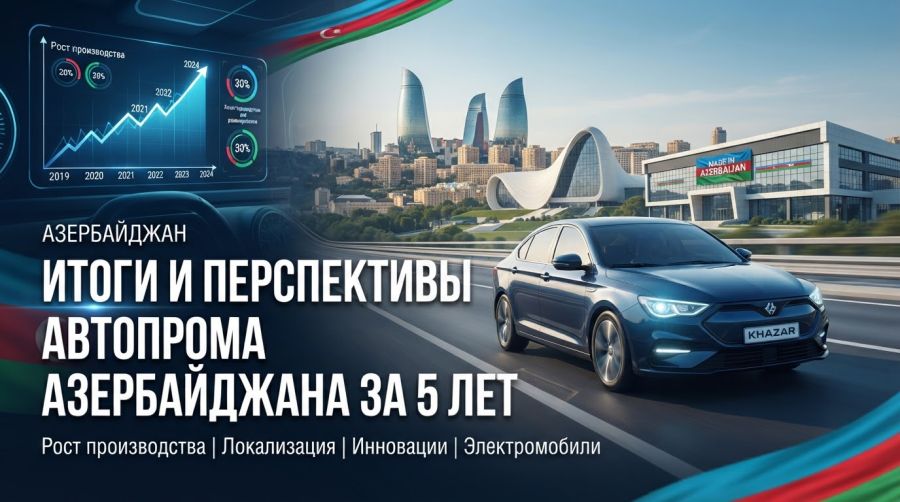
RESULTS AND PROSPECTS OF AZERBAIJAN'S AUTOMOTIVE INDUSTRY OVER 5 YEARS
Over the past five years (2021–2026), the automotive industry of Azerbaijan has achieved a massive qualitative breakthrough. The sector, previously associated solely with finished vehicle imports and piecemeal assembly, has transformed into a key driver of the country's non-oil economy. The expansion of the national auto industry relies on a multi-brand structure, comprehensive state incentives, and deep international cooperation. Production Geography and Key Hubs
The main catalyst for the industry's growth has been the launch of modern enterprises within the country’s Special Economic Zones, where factories have strategically segmented their market niches:
* Hajigabul Industrial Park: The absolute flagship of the national automotive industry. It hosts the Azermash CP joint venture, which handles the mass production of Chevrolet passenger cars (Cobalt, Damas, Labo, Tracker, Onix), maintaining a dominant market share. The facility also assembles Isuzu commercial vehicles and modern family crossovers by VGV (U70 Pro and U75 Plus models).
* Neftchala Industrial District: The pioneer of the new automotive wave. It serves as the base for the national brand Khazar (a joint venture with Iran's Iran Khodro), which shows steady growth (around +13.7% by mid-2026) in the ultra-budget sedan segment. The site is also adapting its lines for the assembly of JAC and Bestune models.
* Ganja Automobile Plant: Holds solid ground in the heavy-duty truck and specialized machinery segment. It has localized the assembly of KAMAZ, MAZ, and UAZ trucks, alongside "Belarus" tractors (in partnership with the Minsk Tractor Works).
* Nakhchivan Automobile Plant: Continues its passenger car assembly operations, demonstrating localized volume growth.
From 2018 through the first half of 2025, the total value of goods produced within these industrial zones exceeded 518 million AZN. Performance Dynamics: The Bus and Truck Boom
Recent statistical data reflects a profound structural shift in the market. While the total annual output in 2021 stood at just over 2,000 units, production rates have multiplied exponentially by 2026:
* Record Leap in the Bus Segment: By the end of 2025, the country produced 477 passenger buses. This figure exceeded the 2020 production volume nearly 240-fold, directly resulting from the large-scale modernization of municipal fleets in Baku and regional centers. The trend solidified in 2026, with bus output increasing an additional 4.3 times in the first five months alone.
* Heavy Transport Growth: Rising logistics demands and the large-scale reconstruction of liberated territories triggered a massive boom in the truck segment in 2026, with production volumes soaring 7 to 8 times compared to previous periods.
Government Support and Tax Incentives
The rapid growth of the automotive industry was enabled by an unprecedented package of fiscal preferences provided by the Azerbaijani government:
* Industrial Park Regime: Residents of the Hajigabul, Neftchala, and Sumgayit parks are fully exempt from corporate income tax, land tax, and property tax for 10 years. They also enjoy exemptions from VAT (18%) and customs duties on imported technological equipment, machinery, and components required for production.
* Alat Free Economic Zone (AFEZ): Offers exporters a total absence of corporate taxes and VAT, free repatriation of profits, and 100% foreign capital ownership.
* Talent Incentives (2026): 20-year tax exemptions (zero income tax rate) were introduced for key specialists and employees of technological parks, significantly lowering human resource and payroll costs for investors.
International Cooperation and Transition to Full-Cycle Production (CKD)
The defining trend of this five-year period is the transition from simple semi-knocked-down (SKD) assembly to the establishment of complete technological ecosystems. The most critical milestone in this direction is the strategic partnership between Azerbaijan and Uzbekistan.
Leveraging the expertise of Uzavtosanoat JSC and the Azerbaijani company Azermash CP, construction began on a new plant in Hajigabul, backed by an investment of over $80 million USD. Scheduled for launch by mid-2027, the facility will mark the transition to a completely knocked-down (CKD) full production cycle. This will incorporate on-site body welding, painting, and deep localization of auto components directly within Azerbaijan.
The "Green" Reset: Focusing on Commercial Electric Vehicles (2025–2026)
The development vector for eco-friendly transport in Azerbaijan has undergone major strategic shifts over the past year. The government pivoted away from passenger electric cars, focusing instead on commercial and public electric transport:
* Launch of BYD Production: The Sumgayit Chemical Industrial Park initiated the production of 12-meter BYD K9UD electric buses. For 2026, the plant’s projected capacity stands at 250–300 electric buses annually. An initial batch of 60 units is already successfully operating on routes across Baku, Nakhchivan, and Khankendi.
* Electric Trucks: Technical negotiations are currently underway to begin assembling BYD T5 light-duty electric trucks around the turn of late 2026 or early 2027. However, local manufacturing of passenger BYD models is not planned at this stage.
In parallel, effective January 1, 2026, Azerbaijan repealed the 18% VAT exemption on the import of finished passenger EVs, which had been in place for over five years. This led to a natural cooling of the market, cutting pure EV imports in half. Domestically, consumer demand shifted toward hybrids and Plug-in hybrids, which buyers find more practical for the region's climate and long-distance travel. Nevertheless, the total share of the "green" fleet in the country has expanded 20 to 30 times over five years, while charging infrastructure continues its rapid rollout nationwide.
The evolution of the automotive industry over the past five years proves that Azerbaijan is successfully establishing an independent, competitive transport engineering cluster. This not only reduces import dependency but also lays a resilient foundation for future vehicle exports to neighboring markets.
Bakuinform.az