

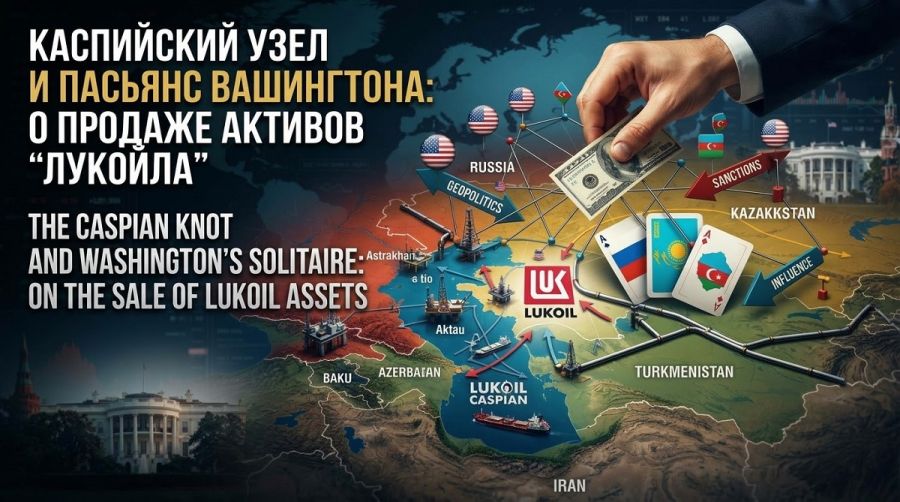
The Caspian Hub and Washington’s Solitaire: On the Sale of Lukoil’s Assets
99
Bakuinform.az
The agreement to sell a 100% stake in the Austrian structure Lukoil International GmbH (LIG)—which consolidates the Russian oil giant’s foreign assets across 11 countries—has become the energy deal of the year. The buyer is a consortium led by American billionaire Todd Boehly (investment holding Eldridge), which also includes investment bank Xtellus Partners, the Emirati Catena Investment Holding, and the U.S. International
At stake is a portfolio with a market value of approximately $16 billion, featuring production of around 350,000 barrels of oil per day, refining capacities in Europe, and a network of gas stations. For the Caspian basin countries, this transaction is not merely a change of ownership, but a fundamental geopolitical shift that ends months of sanctions-induced paralysis across key production and transit projects.
Financial Engineering Without Cash
After Lukoil was hit by blocking sanctions from the U.S. Treasury on October 22, 2025, the company’s attempts to sell its foreign business fell through twice. In November 2025, the U.S. regulator blocked a deal with Swiss trader Gunvor, and in July 2026, a non-exclusive agreement with the American fund Carlyle expired without ever receiving an OFAC license.
Todd Boehly’s consortium proposed an unprecedented non-cash share swap scheme that rules out any dire
• Settlement in frozen securities at a discount. Instead of $16 billion in cash, Lukoil will receive a package of its own shares and securities of other Russian companies worth about $10 billion (a 37.5% discount). The buyers had previously acquired these shares at a discount from U.S. and British funds, as well as depository banks that wrote off their value after they were frozen in 2022.
• Five-year quarantine. The received securities will not be placed directly at Lukoil’s disposal—they will be held in a special escrow account in the UAE for 5 years or until U.S. sanctions are completely lifted.
• U.S. state capitalism. The DFC enters the capital of the new structure with no upfront outlay, gaining a seat on the board of directors and the right to a share of future profits once private investors recover their invested capital and lock in a baseline return.
The Caspian Hub: Which Assets Are Changing Hands
The perimeter of the deal includes key Caspian production and transport projects where the Russian giant had maintained a presence for decades:
Country / Sector Lukoil’s Assets in the Region Sanctions Status and Deal Impact
Azerbaijan 19.99% in the Shah Deniz gas condensate field (operated by BP) and a retail gas station network. The largest resource for the Southern Gas Corridor to Europe. The change of ownership removes sanctions risks from gas supplies to the EU, although the transfer of the local gas station network to the consortium remains subject to clarification, according to Azerbaijani media.
Kazakhstan (Megaprojects) 13.5% in Karachaganak, 5% in Tengizchevroil (TCO). The projects operated under temporary U.S. Treasury (OFAC) exemptions. Transferring the stakes to the American pool permanently removes them from the threat of sanctions blockades.
Kazakhstan (Offshore & Production) 50% in Kalamkas-Khazar Operating (jointly with KazMunayGas), stakes in Turgai Petroleum, and a lubricants plant in the Almaty region. According to KazMunayGas, U.S. sanctions exemptions did not cover the Kalamkas-Sea and Khazar offshore projects, leaving their accounts frozen and prompting talks on Lukoil’s early exit.
Transit (Kazakhstan / Russia) 12.5% in the Caspian Pipeline Consortium (CPC). The main export route for Kazakh oil to global markets. The entry of U.S. capital and the state-backed DFC alters the governance balance of the pipeline.
Turkmenistan and the Trans-Caspian Route: The Domino Effect
Although Lukoil International GmbH has no direct producing assets in Turkmenistan (the previously discussed Dostluk project on the border with Azerbaijan never entered an active investment phase due to sanctions restrictions), the shareholder shift in Baku and Astana directly affects Ashgabat:
• Lifting the political veto on the Trans-Caspian Gas Pipeline. For decades, Russian energy giants acted as the primary informal brake on laying pipelines across the Caspian seabed. Lukoil’s exit from Shah Deniz and the entry of the U.S. state corporation DFC bolster geopolitical support for routes byp
•Nassing Russia.New momentum for the Middle Corridor. Consolidating stakes in Shah Deniz and Kazakh projects under the aegis of a U.S.-Emirati pool makes investments in Trans-Caspian logistics (transshipping Kazakh and Turkmen oil via the ports of Aktau, Kuryk, and Baku into the Baku–Tbilisi–Ceyhan pipeline) more predictable and attractive for Western institutional funds.
How Russia and Iran Are Reacting
The reactions of Washington’s two main Caspian opponents differ noticeably in tone, reflecting their varying degrees of involvement in the deal’s architecture:
• Russia: Pragmatic silence and the logic of a "grand bargain." The official Kremlin and the Russian Foreign Ministry have refrained from harsh public statements, as Lukoil itself is a party to the signed agreement and is forced to rescue its capital from uncompensated nationalization abroad. As the Financial Times notes, the sale of Lukoil’s foreign assets to investors close to the White House featured in closed-door U.S.-Russian consultations as a potential element of economic de-escalation. Meanwhile, Russian financial analysts (such as on Investing.com) view the scheme as a forced measure: the company loses foreign currency cash flow, but in return executes a covert buyback of its own frozen shares at a steep discount.
• Iran: Alarm over the "Americanization" of the Caspian. Official Tehran has not yet issued a separate diplomatic statement on the Boehly deal, being locked in an acute economic and sanctions standoff with the U.S. itself. However, for Iran’s regional strategy, this transaction poses a direct challenge:
1. Violation of the "Caspian for the Caspian states" principle. Tehran traditionally opposes the military and direct state presence of non-regional powers in the Caspian Sea. The entry of the U.S. state-owned DFC into the capital of key projects right on Iran’s doorstep effectively legitimizes Washington’s direct influence over the Caspian energy balance.
2. Derailment of joint projects. Back in 2016–2017, Lukoil and the National Iranian Oil Company (NIOC) signed memorandums on geological exploration in the Iranian sector of the Caspian and oil swap deliveries. The restructuring of Lukoil’s international business permanently puts an end to prospects for joint work on the Iranian shelf relying on the Russian company’s international expertise.
Assessments by Market Participants, Analysts, and Trade Media
Leading global and regional business publications have already outlined their core assessments of the deal’s drivers and consequences:
• Position of Washington and the consortium. In an official statement cited by The Wall Street Journal, the buyers emphasized that the deal aims to "stabilize the operation of energy assets in emerging markets, strengthen energy security, and return billions of dollars to American taxpayers". A DFC spokesperson was even more direct in comments to Reuters: "Transferring strategic energy infrastructure assets into the hands of the U.S. or its allies is a key policy priority of the current administration".
• Assessment of corporate transformation (The Wall Street Journal and CNN). CNN and WSJ commentators note that for Todd Boehly—co-owner of the Los Angeles Lakers and Los Angeles Dodgers, whose $75 billion Eldridge fund specializes in sports, media, and credit—entering the oil and gas sector is an atypical move. At the same time, the WSJ recalls that Lukoil International GmbH’s net book value at the end of 2024 was estimated at €19.5 billion ($21.4 billion), but its sanctioned status forced the Russian company to agree to a massive discount.
• Sanctions risk analysis (Kursiv Media and KMG reporting). The editorial team at business outlet Kursiv Media points to OFAC’s "50 Percent Rule": any joint venture in which a sanctioned entity holds a 50% or greater stake is automatically blocked. Precisely for this reason, according to KazMunayGas’s annual report, the Kalamkas-Khazar Operating project was left without active bank accounts, prompting Astana to draft scenarios for Lukoil’s early withdrawal.
• Geopolitical view from Baku (Globalinfo.az and APA). Political commentator Alabbas Maharramov noted in an interview with Globalinfo.az that Washington’s plan is directly aimed at curbing Russia’s influence in the global energy market and strengthening U.S. positions in strategic regions, including the Caspian. Meanwhile, Azerbaijani news agency APA points out that through the five-year deferred return of its own shares, Lukoil is laying the groundwork to preserve capital in case sanctions are eased in the future.
Summary: Implications for Azerbaijan, Kazakhstan, and the Caspian States
Drawing on trade media assessments, official DFC statements, and regional expert commentary, four main takeaways emerge for the Caspian basin:
1. For Azerbaijan — Full legalization of gas exports and an influx of Western capital.
As Azerbaijani and Western business media note, Lukoil’s exit from the Shah Deniz project (19.99%) completely clears the supply chain of Azerbaijani gas to Europe from any sanctions taint. Direct participation by the U.S. state-owned DFC alongside U.S. and UAE funds (Catena Investment) reinforces Baku’s status as a key guarantor of EU energy security and removes hurdles for European banks financing the expansion of the Southern Gas Corridor.
2. For Kazakhstan — Rescuing exports via CPC, but bargaining over the Caspian shelf.
According to Kursiv Media, unlike the collapsed January deal with Carlyle (which excluded Kazakh assets), Boehly’s consortium aims to buy out the entire portfolio, including stakes in Kazakhstan. This frees Tengiz, Karachaganak, and the CPC from reliance on temporary U.S. Treasury licenses. However, for the Kalamkas-Sea and Khazar projects—where Lukoil holds 50% and accounts are already frozen—the Kazakh government and KazMunayGas must decide whether to exercise their preemptive buyout right (as Astana previously stated) or relaunch the project in partnership with the new U.S.-Emirati consortium.
3. For Turkmenistan — Unblocking the Trans-Caspian agenda.
The departure of Russian capital from key producing and transit assets in neighboring countries deprives Moscow of its primary lever of influence over Caspian energy infrastructure. This opens a new window of opportunity for Ashgabat and Baku to advance Trans-Caspian routes with political and financial backing from the U.S. and the EU.
4. For the regional balance (Russia and Iran) — Shrinking influence and a new status quo.
As indicated in the DFC’s policy statement to Reuters, Washington is shifting from a policy of passive sanctions to direct ownership of strategic Eurasian infrastructure. The entry of U.S. state capital into the CPC and Caspian fields in tandem with UAE capital cements a new reality: the presence of Russia and Iran in key Caspian energy projects is contracting, while control over producing and transit arteries is consolidating in the hands of an alliance between the U.S. and Gulf monarchies. At the same time, according to Todd Boehly’s own estimate, regulatory clearance with OFAC and national authorities will take up to 12 months—during this transition year, regional states will actively reshape shareholder agreements