

Robert E. Hall and Michael Woodford received the Nobel Prize in Economics in 2026.

From Baku Derricks to Swedish Triumphs: How Azerbaijan’s "Black Gold" Created the Nobel Prize
The 2026 Nobel Week has inscribed new names into the history of science. The Sveriges Riksbank Prize in Economic Sciences in Memory of Alfred Nobel was awarded to American scientists Robert E. Hall and Michael Woodford for their revolutionary macroeconomic models. Yet, while the world discusses how their theories help central banks cushion financial crises, we invite you to look behind the scenes of the planet's most prestigious award. Few know that without Azerbaijan, Baku oil, and the engineering genius of the Nobel brothers, this triumph of global science might never have happened.
Economics 2026: Why Was the Prize Awarded?
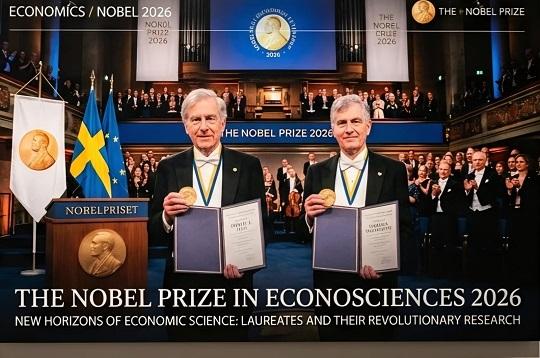
In 2026, the highest honor in economics was bestowed upon Robert E. Hall and Michael Woodford "for microeconomic foundations of macroeconomic stabilization."
The laureates achieved a breakthrough: they proved that the economy is not a blind set of statistical formulas, but the behavior of real people who can think ahead. Their models taught central banks to manage economic cycles through public expectations. If a regulator explains its plans honestly and predictably, businesses and citizens stabilize the market themselves through their investments and spending.
Today, the policies of the US Federal Reserve, the European Central Bank, and the central banks of the South Caucasus countries are built on these very principles. For instance, Armenia and Georgia utilize them within the framework of inflation targeting (FPAS and GEMO models), while the Central Bank of Azerbaijan develops an interest rate corridor system on this basis, successfully combining it with a fixed manat exchange rate.
A Crucial Clarification: History Against the Will
When speaking of the Nobel Prize, it is often mentioned that it has been awarded since 1901. This holds true for physics, chemistry, medicine, literature, and the peace prize, which were anchored in Alfred Nobel's will.
However, the Economic "Nobel" is special. The inventor of dynamite himself did not hold economists in high regard. The prize in economics was established by the Central Bank of Sweden (Sveriges Riksbank) only in 1968 to commemorate its 300th anniversary. It was first awarded in 1969. Although technically not an original Alfred Nobel prize, it enjoys the exact same status: the laureates are chosen by the Royal Swedish Academy of Sciences, and the gold medals are presented at a joint grand ceremony in Stockholm on December 10.
But where does Baku hide in all this global scientific history? The answer is simple: in the very foundation of the Nobel capital.
## The Baku Trail: How a Coincidence Changed Global Science
The connection between the Nobel Prize and Azerbaijan began in 1873 by pure coincidence. Alfred’s older brother, Robert Nobel, arrived in the Caucasus in search of high-quality walnut wood for rifle butts—the family factory in St. Petersburg was fulfilling a military order.
Instead of forests, Robert saw Baku, gripped by the world's first oil rush. Realizing the magnitude of the prospects, he unhesitatingly spent the "walnut money" to purchase a tiny kerosene refinery in Sabunchu.
As early as 1879, the brothers Ludvig, Robert, and Alfred Nobel founded the legendary "Nobel Brothers Petroleum Production Partnership" ("Branobel"). It was in Baku that the Swedish engineers staged a technological revolution:
* They built the first metallic oil pipeline in the Russian Empire.
* They designed the world's first steel tanker for bulk oil transportation ("Zoroaster").
* They launched the first railway tank cars.
At the turn of the 20th century, Baku provided nearly half of the world's oil production, and the Nobel empire became one of the wealthiest and most influential companies on the planet.
How Much Baku Money is in the Nobel Fund?
When Alfred Nobel passed away in 1896, his famous will shocked his relatives. Almost the entirety of the inventor's colossal fortune was to be invested in securities to create a prize fund.
Historians and economists agree: the Nobel Prize was directly funded by revenues from Baku oil. Alfred Nobel's share in the Baku partnership "Branobel" was immense. Upon the liquidation and sale of his Azerbaijani assets and shares, astronomical funds flowed into the Nobel Foundation. According to various estimates, Baku's "black gold" accounted for 12% to 22% of the foundation's initial seed capital. Without the Baku oilfields, the prize simply would not have possessed the financial scale that made it a global symbol of success.
The First Prizes Were Born on the Caspian
Remarkably, the first named Nobel prizes began to be awarded not in Stockholm, but in Baku.
* In 1889, the Baku branch of the Imperial Russian Technical Society established the Ludvig Nobel Prize for achievements in metallurgy and oil refining.
* In 1904, the international Emmanuel Nobel Prize was introduced here for outstanding inventions in the oil business, predating the Swedish awards in the field of applied chemistry.
Today in Baku, in the area of the former Black City, the brothers' family residence—Villa Petrolea—has been carefully restored. Built in the 1880s as a blooming oasis amid a wasteland scorched by oil, today it operates as the first and only house-museum of the Nobel brothers outside Sweden.
Therefore, every time the world holds its breath in October, waiting for the names of new laureates—be it economists Hall and Woodford in 2026 or physicists of years past—it is worth remembering: the golden glow of the Nobel medals originated deep beneath the soil of the Absheron