

Measures to optimize traffic flow in Baku announced
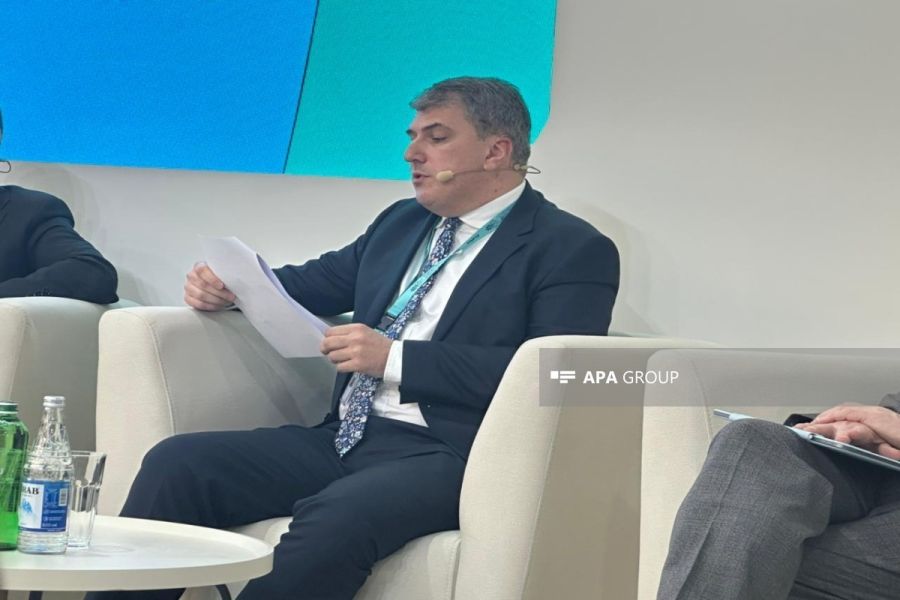
© APA | Fariz Azizov, Advisor on Institutional Development to the Chairman of the Board of the State Agency of Azerbaijan Automobile Roads (AAYDA)
Measures to optimize traffic flow in Baku have been announced, APA reports.
Fariz Azizov, Advisor on Institutional Development to the Chairman of the Board of the State Agency of Azerbaijan Automobile Roads (AAYDA), spoke about this during an event dedicated to Baku’s Master Plan held within the framework of WUF13.
“Today, Baku is simultaneously undergoing several transformations. Perhaps the most difficult aspect of urban planning today is that cities are changing faster than traditional planning models themselves. Just as military strategists are often criticized for preparing for the previous war, urban planning specialists also sometimes face the risk of planning cities according to outdated models of society. However, modern cities are developing too rapidly for static approaches. It is not easy to predict how people will live, work and move in 20 years. Will urban development continue to expand toward suburban areas? Will remote and hybrid work models permanently change transportation flows? Will the cities of the future be shaped around monofunctional business districts or around multifunctional mixed-use urban environments? Perhaps the biggest question is this: how will the role of cities change amid technological, demographic, economic, energy consumption and social transformations? These are extremely difficult questions. However, even if we cannot predict the future with complete accuracy, we have a responsibility to foresee it as intelligently as possible. That is precisely why long-term strategic planning is critically important. In this regard, the ‘State Program on the Improvement of Transport Infrastructure in the City of Baku and Surrounding Areas for 2025–2030’ represents an important stage in Azerbaijan’s urban development policy and also covers highways. This program has been prepared in line with the main principles of the ‘Baku Master Plan 2040,’ and its goal is not only to build roads, but to fundamentally reshape urban mobility as a whole. The goal is not simply to ensure that vehicles move faster from one point to another. The goal is to improve quality of life, reduce structural pressure on cities, create more balanced mobility models, and support the transformation of Baku and the Absheron Peninsula into a sustainable metropolitan space of the future. Today, Baku is becoming a major metropolitan region,” he noted.
Fariz Azizov stated that population growth, urbanization, economic expansion and mobility demands are creating entirely new pressures on transport infrastructure: “That is precisely why the approach of the Azerbaijan State Agency of Automobile Roads goes far beyond the traditional concept of road construction. We are creating alternative transport corridors, redistributing traffic flows, reducing pressure on overloaded city entrances, improving safety standards and building more flexible and sustainable mobility systems. Within the framework of the state program, the Azerbaijan State Agency of Automobile Roads is implementing 26 major road infrastructure projects, and very active construction work is already underway on several of them. First of all, the Bilajari–Khirdalan–Shamakhi highway project is of particular importance. This project will connect the M1 Baku–Guba highway with the M4 Baku–Shamakhi highway and will allow regional transport to completely bypass the city center. The corridor is 29 kilometers long, consists of six traffic lanes and includes nine interchanges, 13 bridges, tunnels and pedestrian crossings. The strategic importance of this project is not limited only to transport optimization, but also creates a new level of metropolitan connectivity. The project will provide residents and logistics flows coming from Absheron settlements with access to northern and western directions without entering central Baku. This means reduced congestion, accelerated logistics movements, minimized time loss and reduced environmental pressure on Baku. Another important project is the new road connection between Academician Hasan Aliyev Street and the ‘Koroglu’ metro station. The implementation of the project is currently nearly 50 percent complete. This project is being carried out in one of Baku’s busiest transport corridors. The project includes four tunnels, an underground pedestrian crossing and solutions ensuring uninterrupted movement. The goal is to create alternative east-west urban connections. The project serves to reduce structural pressure on Heydar Aliyev Avenue and Ziya Bunyadov Avenue and improve the mobility balance between different parts of the city. After the project is completed, the connection between the Keshla, Narimanov and ‘Koroglu’ districts will become faster, safer and more efficient. At the same time, a modern city should be designed not only for vehicles, but for people. That is why pedestrian safety and accessibility are also among the main priorities of the state program and our agency. Projects such as the transport and pedestrian tunnels connecting the ‘Chanlibel’ residential complex and surrounding streets demonstrate a human-centered approach. Here, transport efficiency and pedestrian comfort are ensured simultaneously. Another important direction is the new road connection between Hasan bey Zardabi Street and Hajiaga Rustamov Street, which will help create alternative routes and ensure a more rational distribution of traffic flows throughout the city. Dear colleagues, although each of these projects is important individually, their main strength lies in creating an integrated metropolitan mobility system together with partner institutions. Because modern urban development today requires not separate road projects, but a coordinated system and synergy.”