The Right to Education in Azerbaijani Schools and the Religious Dress Code
Commentary by Bakuinform.az
Resolution No. 309 adopted by the Cabinet of Ministers of Azerbaijan, which approved the new standards for a unified school uniform, provoked a predictable but artificially fueled resistance from the conservative segment of society [caspianpost.com, 4kids.az]. The situation surrounding the refusal to admit female students wearing hijabs into classrooms quickly transcended the format of local discontent, escalating into street incidents and information attacks. However, is it not clear that behind the slogans of the defenders of "thin scarves" lies a far more serious problem: the systemic penetration of a strict religious dress code into modern secular schools and a deliberate, distorted understanding of the essence of the right to education.
The Trap of Terms: Why the Hijab is Not "Just a Scarf"
The main manipulation used by critics of the school reform in the media space is an attempt to blur definitions. Religious protest is often camouflaged as the defense of a "traditional headwear" or a "thin scarf." However, sociological and confessional analysis of the situation reveals a fundamental difference.
While a regular scarf or headscarf (such as the national Azerbaijani kalaghai) is an element of historical costume and cultural identity that does not carry the function of strict confessional division, the hijab is a full-fledged and uncompromising religious dress code that requires the strict concealment of certain parts of the body according to the canons of Sharia.
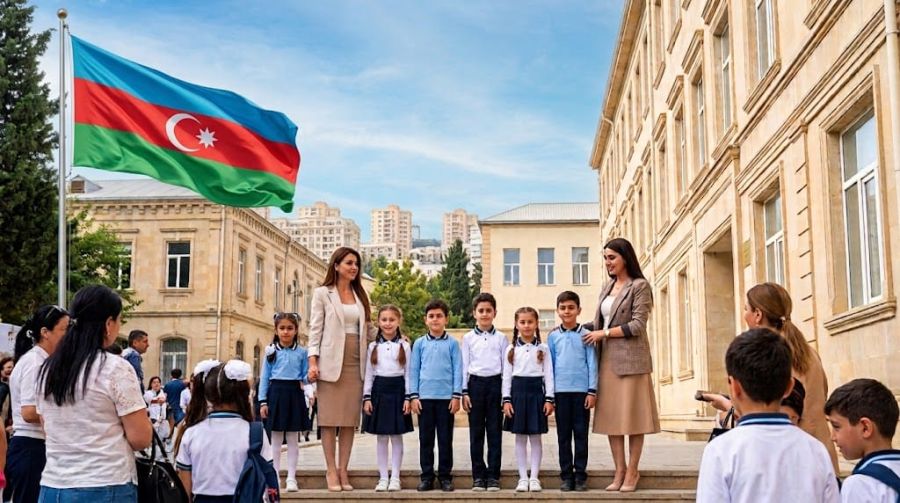
When this attribute penetrates a modern school of general education, it inevitably conflicts with the very idea of general education and a unified school uniform. This comes at a time when the uniform is established by the state as an instrument of social equality, designed to erase financial, ethnic, and religious barriers among students during the educational process. The appearance of a pronounced religious marker in the classroom instantly dismantles this inclusive environment, creating unnecessary precedents, covert psychological pressure on uncovered peers, and a visual split within the student body.
Distortion of the Right to Education: Obligation Versus Manipulation
The second important aspect of the crisis is how the protesting side interprets legal norms. The thesis that secular prohibitions violate Article 42 of the Constitution of Azerbaijan (The Right to Education) is being actively pushed into the public sphere. But in this case, a fundamental substitution of concepts takes place.
* Right as an obligation: The Constitution does not simply grant a citizen the "right" to enter a school building in any attire. Secondary education in Azerbaijan is compulsory. The state undertakes the obligation to provide this knowledge, but within the framework of its institutions and according to its rules.
* Rules of a secular institution: A state school is not a religious community. Obtaining an education in a state institution imposes reciprocal obligations on a citizen—to comply with the school charter, the curriculum, and the legally established appearance.
The administrative collision where schools record the truancy of children whose parents refuse to bring them in proper attire arises precisely due to the destructive position of the parents themselves [4kids.az]. Families, in essence, consciously sacrifice the real education and future of their daughters for the sake of a demonstrative adherence to a religious qualification that they are trying to impose on the secular system. The right to education is manipulated here, used as a shield to advance a conservative agenda.
The Result of Long-Term Acquiescence
What is happening today in Azerbaijan is a direct result of the fact that in previous years, the relevant agencies and administrations of educational institutions turned a blind eye to the creeping introduction of religious attributes in schools. Due to the lack of strict control on the ground, a false mindset became entrenched in the minds of a certain segment of citizens: if the administration remains silent, it means state rules can be ignored.
Today, when the Cabinet of Ministers has clearly outlined the secular boundaries, the system has faced the fruits of its own past passivity. The expansion of the religious dress code had to be halted using strict administrative methods.
How to Solve the Problem? Ways out of the Crisis Based on Expert Opinion
The current impasse and the risks of rising female illiteracy in conservative regions require systemic steps from both the state and society. The solution to the problem must lie not in the plane of concessions to religious pressure, but in the creation of clear legal and educational mechanisms:
1. Legalization and Regulation of Home Schooling (Homeschooling):
In Azerbaijan, it is necessary to develop a clear framework for family (distance) education at the legislative level. If a conservative family categorically refuses to accept the rules of a secular school, the state must provide the child with an alternative: to study at home under the supervision of the Ministry of Education, regularly pass rigorous state exams (as an external student), and receive a school certificate. This will protect girls from complete isolation and illiteracy.
2. Clear Secular Regulation for a "Minimum Compromise":
If a total ban on headwear leads to a massive dropout of children from schools, the Ministry of Science and Education can introduce a strict standard for a compromise option. This does not refer to the hijab, but to a regular solid-colored headwear (for example, a special knit bony cap or a laconic scarf) that is strictly integrated into the approved school uniform by color and fabric. This will allow believers to observe basic ethical norms but will remove an aggressive confessional marker from the classroom.
3. Strengthening the Legal Liability of Parents:
It is necessary to tighten control by guardianship authorities and commissions on juvenile affairs. If parents do not utilize alternative forms of education and simply do not allow the child to go to school, depriving them of a future for the sake of their beliefs, strict administrative sanctions must be applied. A child's right to knowledge must be protected by the state from the radicalism of their own family.
4. Large-Scale Awareness Campaign:
State institutions, sociologists, and the moderate clergy (Caucasus Muslims Office) must conduct coordinated information work. A simple truth must be conveyed to citizens: secular schools do not fight faith, they ensure equality. Religious upbringing is the area of responsibility of the family and the mosque, but within the space of science, the laws of the state apply.
International Context: Protecting Secular Sovereignty
Azerbaijan is not alone in its position. Central Asian countries, which have also faced the aggressive penetration of religious dogmas into the state sphere, are acting similarly. Kazakhstan has legislated a total ban on any headwear and religious markers in schools, harshly punishing parents with fines for failing to comply with secular laws and revoking the licenses of private schools for aiding Islamization [kz.kursiv.media]. Uzbekistan, after brief attempts to compromise with "national scarves," also returned to strict control upon realizing the risks of youth radicalization [asiaplus.news].
For official Baku, this experience became a key guideline. Any concession on the issue of the school dress code within the country will be perceived by conservative circles as weakness. This will immediately open the door to new demands—ranging from segregated education for boys and girls to altering the secular curriculum to appease religious dogmas.
What Should Be Taken into Consideration to Resolve the Problematic Situation
Widespread exposure and clarification of the essence of the problem is what Azerbaijani society acutely needs today. It must be openly acknowledged: school is a space of law, science, and equality, not a platform for demonstrating religious beliefs. The hijab is not an innocent piece of clothing, but a marker of a religious dress code that is inappropriate in a secular educational institution. Parents who consciously keep their daughters from attending classes due to an unwillingness to follow uniform rules must understand that they are not "fighting for rights," but are breaking the law and depriving their children of a future by misinterpreting basic constitutional principles.